

What’s the Difference Between Cheap and Commercial Inflatables in Australia? (A Deep Dive)

If you are looking at buying an inflatable in Australia, the price gap is the first thing you will notice. On a screen, a residential bouncer and a professional-grade unit might look similar, but the cost difference is significant. The real question is not just why one is cheaper, but what you are actually getting for your money—and whether it can survive the harsh reality of the Australian environment.
In Australia, extreme UV exposure, high temperatures, and the demands of frequent outdoor use put more stress on equipment than in almost any other market. Here is a deep dive into the fundamental differences between “cheap” residential units and true “commercial-grade” inflatables.
1. Material Integrity: Beyond Simple Thickness
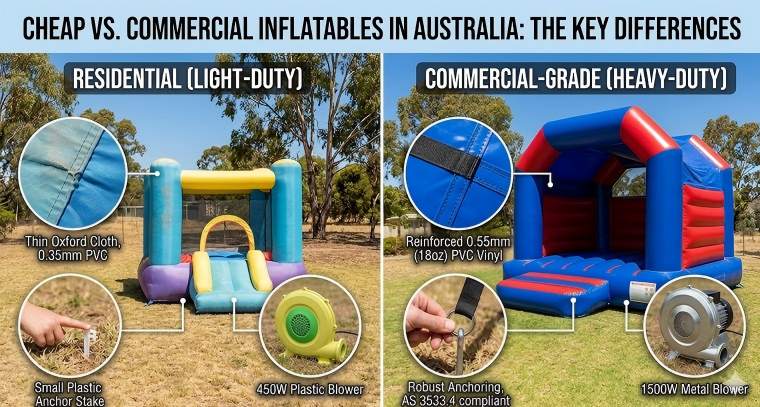
The first major difference lies in the fabric. Cheap inflatables are typically made from lightweight nylon or thin polyester (Oxford cloth), often around 0.35mm to 0.45mm. While these are easy to carry, they have a major flaw: they rely on a tight weave to hold air, which stretches and weakens over time. In the intense Australian sun, these materials can become brittle and prone to “pinhole” leaks within a single season.
Commercial inflatables are engineered from heavy-duty 0.55mm (18oz) PVC Vinyl. This is a high-tenacity polyester base fabric coated on both sides with PVC. It is not only much thicker but also UV-treated and flame-retardant. This industrial-grade material maintains its structural integrity and vibrant colour even after years of exposure to the Australian sun, making it the only viable choice for professional use.
2. Engineering and Hidden Reinforcements
The longevity of an inflatable depends on its “skeleton.” Cheap units often feature basic double-stitching and lack internal reinforcement. Under the pressure of multiple users or high-energy jumping, the seams—the most vulnerable part of any inflatable—can begin to pull apart or fail entirely.
Commercial units are built with triple or quadruple stitching in all high-stress areas. Furthermore, professional manufacturers use Reinforced Webbing (extra strips of heavy-duty material) along the seams and internal baffles. This ensures the unit can handle the “instant pressure” of adults or several children jumping at once without catastrophic failure. If you are running a rental business, this invisible reinforcement is what turns a purchase into a long-term asset.
3. Safety Standards: The AS 3533.4.1 Requirement
In Australia, safety is not just a preference; it is a legal compliance issue. Cheap inflatables are generally classified as “toys” and do not meet the rigorous standards required for public or commercial use.
True commercial inflatables are designed to meet Australian Standard AS 3533.4.1 (Land-borne inflatable devices). This standard dictates everything from the height of the containment walls to the specific strength of the anchorage points (D-rings). For operators, compliant equipment is the only way to secure Public Liability Insurance and gain permission to operate in local council parks or school events. Using a non-compliant “cheap” unit for a business event in Australia exposes the owner to massive legal and financial liability.
4. Operational Efficiency and Maintenance
In a market like Australia, where labour costs are high, how “easy” a unit is to manage directly affects your profit.
- Blower Performance: Commercial units require high-output blowers (usually 1.1kW to 1.5kW) to maintain the high internal pressure necessary for safety.
- Modular Design: Professional slides often feature removable slide sheets and stair covers attached with heavy-duty Velcro. Since these are high-wear areas, you can simply replace the cover rather than retiring the entire $3,000+ unit.
- Rapid Deflation: Commercial units include multiple deflation zippers with internal flaps. This allows you to pack up a large castle in minutes, significantly reducing the time and effort required at the end of a long event.
5. Upfront Price vs. Real Return on Investment (ROI)
While a cheap inflatable is attractive for its low entry price, its “real cost” often emerges later through frequent repairs, lost bookings due to equipment failure, or the inability to pass safety inspections.
Commercial inflatables are an investment. They are built to be “booked out” every weekend. In the Australian rental market, a well-maintained commercial unit can often recover its initial cost within a few months of hire. Because they use 0.55mm PVC, they also hold a much higher resale value, allowing you to cycle your stock and keep your fleet looking professional.
Which Option Makes Sense for You?
- Residential Units: Suitable for occasional backyard use (2-3 times a year) for a single family with small children.
- Commercial Units: Essential for rental businesses, indoor play centres, schools, and corporate events.
In Australia, many new operators try to save money by starting with residential units, only to find they need to upgrade within a year because the equipment simply cannot keep up with the demand. If you want reliability, safety, and a professional reputation, commercial-grade is the only way forward.