

What rules apply to inflatables in Australia?

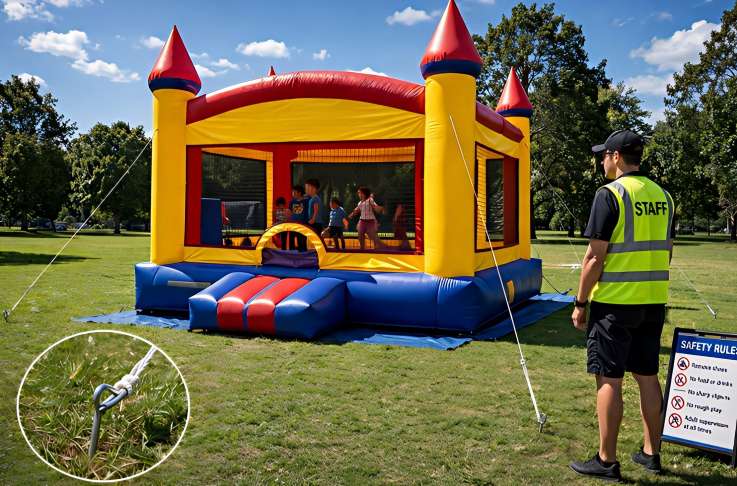
What rules actually apply when you’re running inflatables in Australia day to day?
Most people don’t really think about the rules until they’ve already started doing weekend hires or setting up for a school or backyard event. But once you’re operating regularly, you quickly realise there are a few basics you can’t ignore — especially around safety, weather, and setup.
Here’s how it usually works in real life across Australia.
Safety standards and equipment expectations
In Australia, there isn’t just one single rulebook everyone follows, but most operators stick to recognised safety standards.
A lot of commercial inflatables are made to meet standards like EN14960, even if they’re not always strictly enforced in every situation. In practice, using properly manufactured equipment just makes things easier — especially if you’re working with schools, councils, or public events.
People will often ask about safety, so having equipment that looks and feels professional matters more than you might expect.
Wind limits are taken seriously
If there’s one thing that experienced operators don’t ignore, it’s wind.
Across Australia, a commonly accepted rule is:
- Avoid operating inflatables when wind speeds reach around 20–25 mph (32–40 km/h)
In reality, most operators will pack down earlier if the weather starts looking unstable. Afternoon wind changes are pretty common in places like Sydney, Melbourne, and even regional areas, so you learn to keep an eye on it.
A quiet morning can turn into a windy afternoon faster than expected.
Anchoring is where many problems happen
Proper anchoring is one of the most important parts of setup.
On grass, this usually means:
- Using all anchor points
- Securing with ground stakes
- Keeping tension on the straps
For harder surfaces, sandbags are used, but on typical backyard hires, stakes are the standard.
A lot of incidents you hear about come down to poor anchoring, not the inflatable itself.
Supervision during hires
In most rental situations, supervision is expected at all times.
That usually means:
- An adult nearby while the inflatable is in use
- Keeping an eye on how kids are playing
- Stepping in if things get too rough
For school events or larger setups, there’s often someone assigned specifically to watch the inflatable.
It’s not complicated, but it does make a big difference in keeping things safe.
Basic user rules still matter
Even for simple backyard hires, there are a few rules that apply almost everywhere:
- Shoes off before entering
- No sharp objects or food inside
- Keeping similar-sized kids together
- Avoiding climbing on walls or netting
Most of this is common sense, but it’s the kind of thing that prevents injuries and damage.
Insurance is common for business use
If you’re running inflatables as a business in Australia, public liability insurance is usually part of the setup.
This helps cover:
- Injuries
- Property damage
- Accidents during hires
Some venues and councils will actually require proof of insurance before allowing setups.
Local councils and event requirements
For private backyard hires, there usually aren’t many formal requirements.
But once you move into:
- School events
- Community festivals
- Council spaces
You may need:
- Permission to operate
- Safety documentation
- Proof of insurance
Each council can be slightly different, so most operators learn what’s required in their local area over time.
Final thoughts
Running inflatables in Australia isn’t overly complicated, but the basics matter.
Most experienced operators focus on:
- Watching the weather
- Setting up properly
- Using secure anchoring
- Keeping an eye on users
Once you get into the routine, it becomes second nature. And in most cases, keeping things simple and safe is what keeps the business running smoothly week after week.